

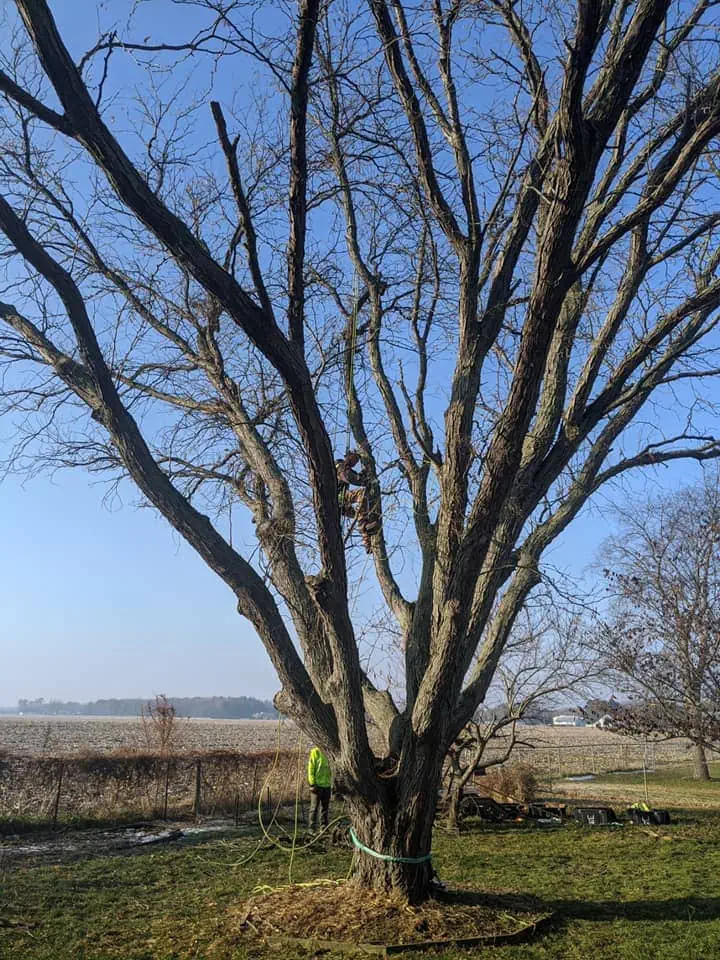
Many homeowners wonder whether watering mature trees is necessary during a dry Illinois summer and how to do it without causing harm. Watering mature trees can seem straightforward, but incorrect timing, volume, or technique can stress trees and reduce long-term health.
Without clear guidance, property owners may under-water and watch canopy decline or over-water and create shallow roots that make trees vulnerable to future droughts. That uncertainty is stressful when storms, heat waves, and prolonged dry spells become more common in central Illinois.
This article gives practical arborist advice to help you decide when and how to water mature trees. You will learn simple deep-watering methods, mulching and soil checks for drought tree care, and when to call a certified arborist for help.
Do Mature Trees Need Supplemental Watering During a Dry Summer?
Mature trees usually have established root systems, but extended dry periods can still cause moisture stress in the topsoil where feeder roots live. Supplemental watering supports healthy trees by keeping roots functional and reducing leaf loss and branch dieback.
Water needs depend on species, soil type, and recent weather, so avoid a one-size-fits-all approach. Observe tree canopy cues like early leaf wilting or leaf scorch and adjust watering accordingly rather than following a fixed calendar.
How Much and How Often Should You Water Mature Trees?
Aim for deep, infrequent watering that wets the root zone rather than surface wetting that encourages shallow roots. For most mature shade trees, providing roughly 10 to 20 gallons per inch of trunk diameter per application is a useful guideline, but adapt that amount based on soil drainage and tree species.
Repeat deep watering every two to four weeks during dry spells for many trees, increasing frequency for shallow-rooted species or compacted soils. Check soil moisture 6 to 12 inches below the surface before re-watering to avoid over-saturation.
How to Check Soil Moisture and Water Distribution
Use a soil probe or a screwdriver to test moisture at several locations around the dripline and beyond, because feeder roots can extend well past the canopy. Moisture should be present below the surface for several inches to count as effective watering.
Even distribution is important, so avoid concentrating all water at the trunk. Water applied near the root flare can run off or cause bark problems, while water applied across the projected root zone encourages lateral root activity.
The Best Time of Day and Techniques for Deep Watering
Water early in the morning to reduce evaporation and allow water to soak in before daytime heat increases stress. Morning watering also helps leaves dry quickly if they get wet, lowering disease risk compared with evening irrigation.
Technique matters: use slow-emitting soaker hoses, a root-ring basin, or a hand-held hose on low flow to allow water to penetrate deeply. Avoid high-pressure sprinklers that wet only the surface and promote shallow rooting.
Watering Trees in Compacted Soil or Heavy Mulch
Compacted soils slow infiltration, so water more slowly in small increments and allow time between cycles for percolation. If mulch is piled against the trunk, move it back to the root zone edge so water reaches soil rather than pooling on mulch and evaporating.
Avoid Frequent Shallow Watering That Encourages Weak Root Systems
Frequent light watering creates a thin wet layer near the surface that feeder roots inhabit, reducing deeper root growth and making trees vulnerable to later drought. Consistent shallow irrigation can change root architecture and reduce overall resilience.
Instead, focus on deep soaking that reaches several inches or more below the surface to stimulate roots downward. This approach supports healthy trees and helps them tolerate periods without rain by relying on deeper soil moisture reserves.
How Mulching Improves Water Efficiency During Drought
Mulch conserves soil moisture, moderates soil temperature, and suppresses competing grasses and weeds that steal water from trees. Apply a 2 to 4 inch layer of organic mulch across the root zone, keeping it pulled back from the trunk to avoid bark damage.
In heat stress situations, trees lose water faster than they can absorb it, making proper deep watering and mulching vital for survival. Monitoring soil moisture and adjusting mulch depth as needed helps support long-term tree health without overwatering.
Pruning Considerations and When to Bring in Professional Help
Selective pruning can reduce transpiration demand after severe drought or storm damage but should be done conservatively to avoid over-stressing trees. For structural pruning or to address storm-damaged limbs, rely on skilled crews and certified advice to protect long-term health.
If you notice large dead limbs, root collar decay, or leaning that developed during a drought, consult professionals for an assessment. Beez Trees recommends professional tree trimming and pruning when pruning needs go beyond routine maintenance and when structural safety is a concern.
Emergency Warning Signs and Certified Arborist Evaluations
If a tree shows sudden canopy collapse, large split branches, or root heave after a drought or storm, those are signs that immediate action may be required. For urgent safety hazards created by drought-stressed trees, emergency contractors may be needed to reduce risk to people and property.
Beez Trees provides 24/7 emergency tree removal and storm cleanup for situations that threaten safety around homes or streets. For non-emergency but complex health questions, schedule ISA-certified arborist consultations and tree health evaluations to get species-specific guidance rooted in best practices.
Related Resources for Next Steps
For more detail, review Beez Trees’s professional tree trimming and pruning services page and its24/7 emergency tree removal and storm cleanup resource before making a final plan. These pages provide additional context about the services and decisions discussed above, while keeping the focus on what applies to your property and priorities.
You can also exploreISA-certified arborist consultations and tree health evaluations when that aspect of the project affects your situation. For independent background,In heat stress situations, trees lose water faster than they can absorb it, making proper deep watering and mulching vital for survival. offers high-authority educational guidance that supports a careful, informed decision.
Frequently Asked Questions
1. How Often Should I Water Mature Oak Trees in Champaign-Urbana, IL During a Drought?
Beez Trees recommends adjusting watering frequency based on soil moisture and tree symptoms rather than a fixed schedule.
In Champaign-Urbana, IL, check soil moisture 6 to 12 inches down before re-watering mature oaks.
Deep watering every two to four weeks is common in long dry spells, with adjustments for soil type and tree condition.
If you are unsure, have Beez Trees perform an assessment to tailor a plan for your oak.
2. Can Overwatering a Mature Maple Tree Cause Root Rot in Champaign-Urbana, IL?
Overwatering can create saturated soils that lead to root decline, and Beez Trees warns against frequent shallow irrigation.
In Champaign-Urbana, IL, ensure soil drains and test moisture below the surface before adding water.
Apply water slowly to encourage deep penetration rather than surface wetting that prolongs saturation.
An ISA-certified arborist from Beez Trees can evaluate soil conditions and root health for a proper diagnosis.
3. What Are the Signs of Drought Stress in Mature Trees in Champaign-Urbana, IL?
Look for leaf wilting, early leaf drop, leaf scorch, and branch dieback; these indicate the tree is under moisture stress.
Beez Trees also watches for brittle twigs and reduced new growth as warning signs during a dry season.
If these symptoms appear around the dripline or across major limbs, supplemental deep watering may help.
Contact Beez Trees in Champaign-Urbana, IL for an arborist evaluation if symptoms are severe or progressive.
4. Can Mulching Help Trees Survive a Dry Summer in Champaign-Urbana, IL?
Proper mulching conserves soil moisture, reduces temperature swings, and limits competition from turf and weeds, and Beez Trees recommends mulch as part of drought tree care.
Place mulch across the root zone but keep it away from direct contact with the trunk to prevent decay.
Maintain a 2 to 4 inch depth of organic mulch and replenish it as it breaks down.
Beez Trees in Champaign-Urbana, IL can advise on the correct mulch type and placement for your property.
Conclusion
Understanding watering mature trees starts with clear information, realistic priorities, and attention to the details that affect your property. Homeowners in Champaign-Urbana, IL can use the points in this guide to compare options, ask better questions, and make a confident next decision.
Beez Trees Is Ready to Help in Champaign-Urbana, IL
Beez Trees brings ISA-certified arborist expertise to homeowners and businesses in Champaign-Urbana, IL, helping assess when supplemental watering is appropriate and how to protect tree health. If you need a tailored tree health evaluation or guidance on deep-watering techniques and mulch placement, use the company website or contact form to request an assessment. For urgent hazards, Beez Trees also offers emergency response to reduce risk quickly.

